
Three upcoming events to flag: Big Tent Urbanist Party on August 13, Keep Families in the City on August 16, and A Conversation With Ald. Bennett Lawson on August 19.
Daniel Koslovsky is a recurring contributor for A City That Works. He’s also written for the University of Chicago’s Becker Friedman Institute, Streetsblog Chicago, and Crain’s Chicago Business.
Regular readers of A City That Works are well aware of the growing housing crisis facing Chicago. The good news, as previously laid out by this blog, is that the city and state are at least starting to address the zoning rules that make it harder to build housing across the city.1
However, if we don’t also reduce the cost of new construction, zoning code reforms alone won’t generate enough new development to overcome the city’s shortage of 128,000 affordable homes. Recent research found that construction costs are the biggest driver of increasing break-even rents2 in the city and that they are accelerating faster than the national average.
To address this issue we need to reform Chicago’s building code as well. The poster child for these efforts has been single-stair reform, which would make it easier and cheaper to build affordable, multi-family units. But that’s just the starting point – there are a number of other elements of Chicago’s building code that raise construction costs, while providing minimal safety benefits.
Richard first wrote about this problem back in 2024. Today, we’re kicking off a recurring series to dig into the code changes that could make it cheaper to build in Chicago, and help deliver lower rents and safer buildings in the process. In particular, we will be examining the following:
Plumbing code restrictions that limit the use of polyvinyl chloride (PVC) and cross-linked polyethylene (PEX) plastic piping and tubing
Restrictions on the use of mass timber for buildings 6+ stories
Elevator cabin size, accessibility, and other requirements
Other areas where Chicago’s code is out of step with the rest of the country such as requirements for electrical conduit (metal piping), excessive accessibility requirements, and an opaque building code update process
Today, we’ll take a brief look at the cost premiums and safety considerations of each of these items. Then we’ll examine the second order implications, and the political constraints that have kept these rules in place.
Known Costs and Uncertain Benefits
Plumbing: Currently, Chicago code prohibits developers from using PVC and PEX plastic piping and tubing in residential buildings with a height exceeding 60 feet. This forces mid and high-rise multifamily buildings to be built with more expensive cast iron or copper piping. David Lapidus, a Chicago area multifamily housing real estate developer, estimated that allowing plastic piping and tubing could save 5-10% on total construction costs.

PVC piping. Source: The Vinyl Institute.
The code is ostensibly in place to improve fire safety in mid and high rise buildings, but neither of the two dominant plumbing codes adopted by most jurisdictions in the US (the International Plumbing Code and the Uniform Plumbing Code) impose any height limits for plastic pipe use. Chicago’s 60-foot restriction is out of step with most of the country, which does not see plastic piping as a fire hazard worth restricting.
Mass timber: Chicago’s allowable-height rules push many mid-rise buildings greater than five stories into more expensive “noncombustible” construction types. Crucially, this prevents developers from using mass timber as the primary building material. David estimates that on one 50,000 square foot project he is currently working on, his company could have saved 10% on overall construction costs if mass timber were an option.
Prior code updates in Chicago illustrate the potential impact of relaxing restrictions on timber construction. Annual permits issued in the city for five story residential and mixed-use buildings essentially doubled after the city’s code was updated to allow wood framing for interior walls starting in 2021.
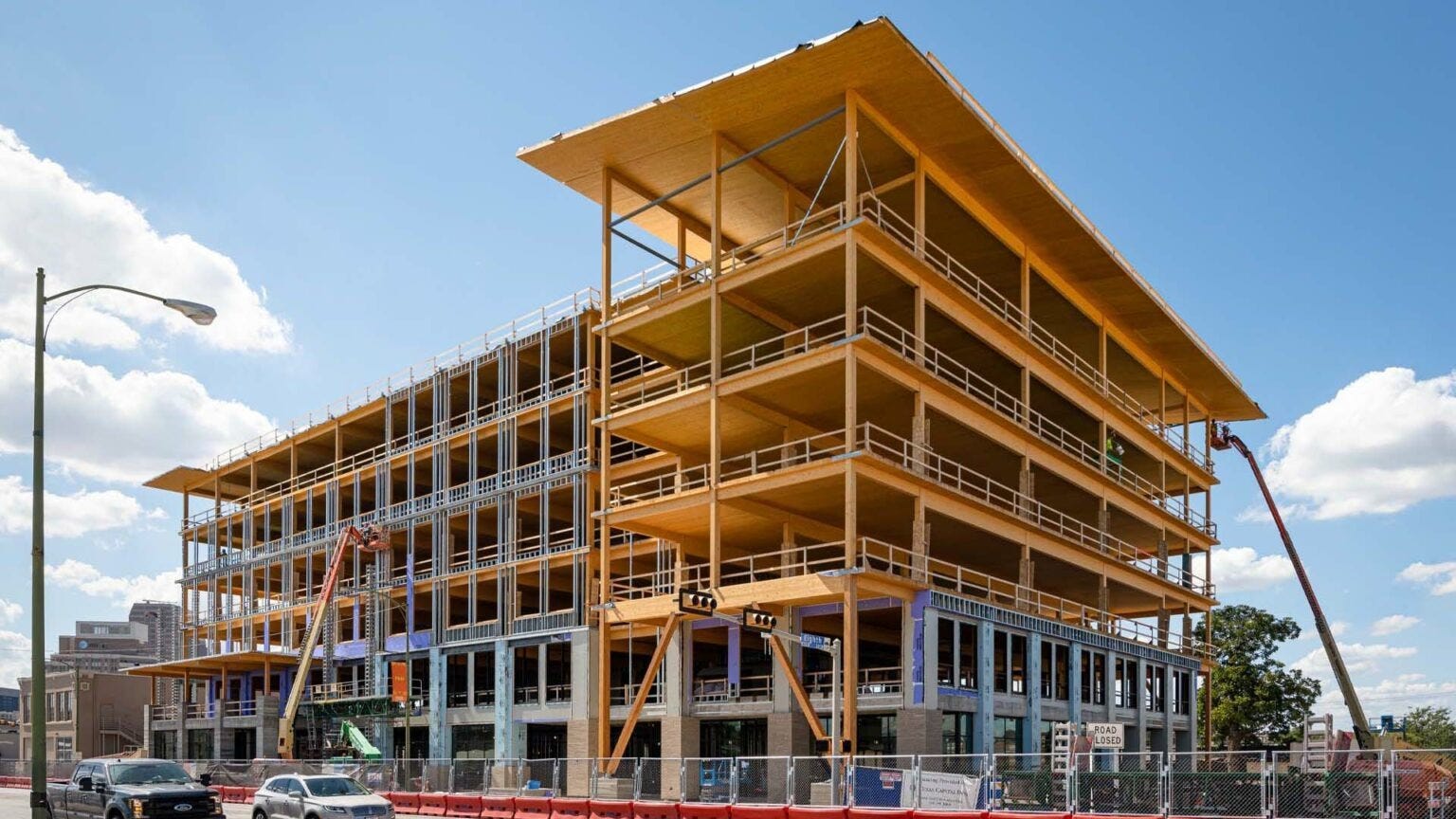
Construction of a mid-rise building using mass timber. Source: Woodworks.
Similar to plastic piping, the justification given for limiting mass timber to five stories is fire safety, but this restriction is not aligned with current guidelines. The modern International Building Code, which most jurisdictions in the US adopt, now permits mass timber to be used for buildings up to at least nine stories generally, and all the way up to 18 stories in some cases.
Elevators: Chicago’s building code requires that buildings six stories or higher have at least one elevator with a cabin large enough to accommodate a fully horizontal ambulance stretcher.3 This cabin size requirement is the norm throughout the US and Canada. In comparison, the rest of the developed world typically only requires elevator cabins to be large enough to fit a wheelchair plus one person.
The larger cabin size is one of the primary reasons it costs three times as much to construct an elevator in the US and Canada as it does in Western Europe. The larger cabins are not only more expensive to build, they also reduce the feasibility of new developments by decreasing the amount of rentable space by an estimated 5%.
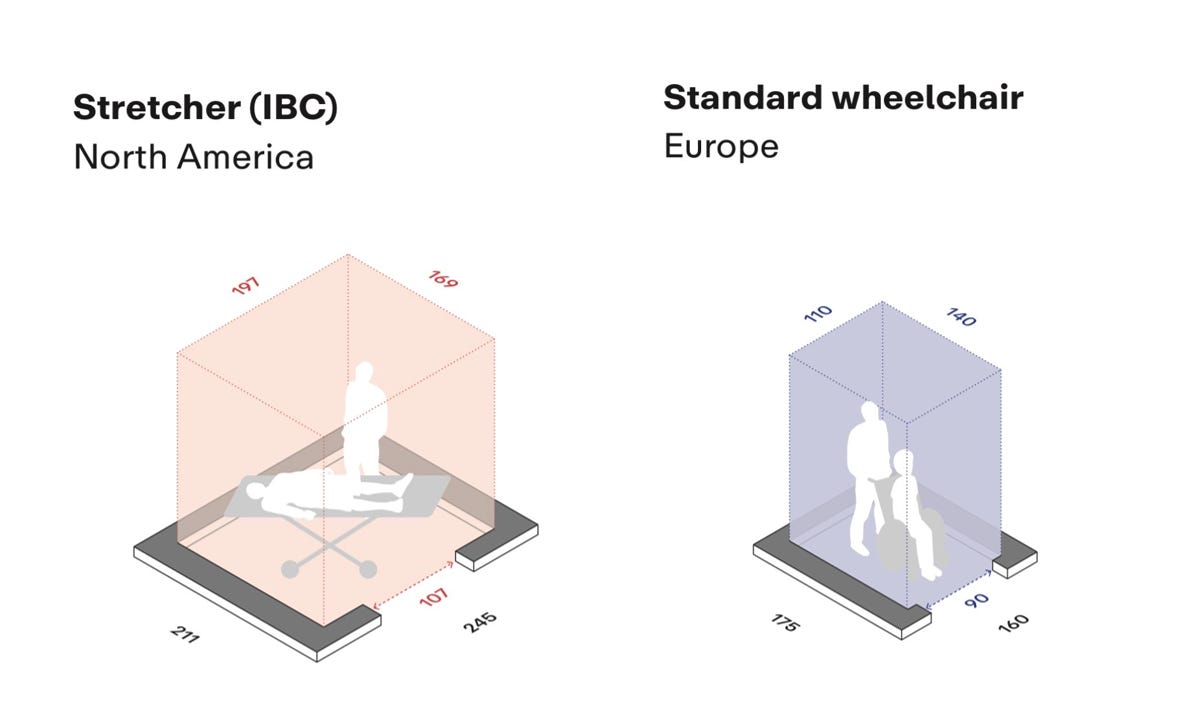
Comparison of the minimum elevator cabin sizes in most of Europe and most of North America. The measurements are in centimeters. Source: The Center for Building in North America.
The larger cabin size is mandated to accommodate emergency responders in the event they need to transport someone in a medical crisis in a fully reclined stretcher. While that is a noble motivation, such events are exceedingly rare and emergency responders are experienced at working around the absence of large elevator cabins.4 The extra cost also perversely incentivizes developers to exclude elevators from their projects altogether when possible, depriving tenants of the safety benefits a smaller elevator would provide.
Individually, the extra costs from these codes are enough to sink housing developments that would otherwise be just profitable enough to get built. Collectively, they present a serious financial hurdle for medium to large housing developments, ballparked to be 20%-25% of construction costs for a project constrained by all three codes, in a city in desperate need of more homes.5
In addition to resulting in less housing overall, high construction costs contribute to disinvestment in lower income neighborhoods. When construction costs are high, developers have to be able to command high rents or sales prices in order to get projects to pencil. That means investment is restricted to a small set of already affluent neighborhoods, while housing stock in lower income communities continues to age.
Hidden health costs
Paradoxically, by stalling the construction of new homes in the name of safety, the highlighted codes are making Chicagoans less safe in meaningful ways. A 1999 paper by Harvard researchers tried to quantify these secondary effects. They broke them down into two categories — stock effects and income effects.
Stock effects are the negative impacts of having an older, less safe housing stock. Older housing is more likely to contain hazards, provide less fire protection, and be in substandard condition generally. That describes a lot of Chicago housing today - the median home in Chicago is more than 70 years old.
Income effects are the negative health impacts of people having to spend more on housing if they want to attain the same quality of home. A portion of the money families must spend on more expensive housing would have gone towards healthcare and lifestyle improvements. Foregoing that spending has real health consequences.
The study’s authors find that every 0.1% increase in construction costs leads to between two and sixty premature deaths per year nationally. Translating the low end of this premature deaths estimate to a 20%-25% increase in construction costs these codes are estimated to incur, means a conservative rough estimate of the premature deaths in the Chicago area resulting from the cost premium of these codes is about 13 to 16 people annually.6
There are further negative consequences not accounted for by this paper.
First, by making the city’s housing less dense people will be forced to more sprawling communities and live a more car-oriented lifestyle. Driving is a much more dangerous activity than living in a multifamily unit with slightly relaxed building codes. A recent Pew study found that multifamily housing built after 2010 had a fire death rate of 0.5 per million people. Meanwhile, 15,000 miles of driving, the yearly distance driven by the average American, results in roughly 180 fatalities per million people.7
Additionally, for some households, the extra cost of housing is the difference between having a home and living on the street. There is a well established relationship between the cost of housing in a metropolitan area and its rate of homelessness. People experiencing homelessness are at a much higher risk of experiencing health and safety issues than the general population, even after controlling for things like income, education, and race.
Absence of cost-benefit analysis
Building codes are valuable. They set minimum safety standards that give us all peace of mind. Their benefits are felt at both the individual and community level. I can rest easy knowing that I’m not living in a tinderbox, and that my neighbor’s building isn’t at risk of producing a fire that spreads fast enough to take down the whole neighborhood (something Chicago is all too familiar with). Codes also reduce transaction costs by harmonizing standards across the construction industry.
But to enact optimal policy, lawmakers need to soberly weigh the costs of these codes against the benefits they provide. By not fully accounting for a code’s costs, they may end up harming the people they are trying to protect. In the case of the codes highlighted in this series, not only do they cost Chicagoans more in monthly rent and mortgage payments, the secondary effects of those extra costs erode any of the limited safety benefits they may provide.
The politics of reform
On paper, relaxing these codes seems like a clear net positive. Unfortunately, they remain in place because the political economy for them has long been asymmetric. We will dive into specifics more in later articles, but to characterize the landscape broadly — concentrated, powerful interest groups fight to maintain the current codes without much organized push back.
Fire departments support the stricter codes because they are incentivized to promote the safety of their firefighters and the fire safety of the city above all else. Understandably, they are not particularly concerned with the cost these codes add to building homes. Thus, any code that might provide extra fire protection, even ones like restrictions on plastic piping and tubing where the safety benefits are up for debate, are likely to be supported by CFD.
Unions in the building trades often support the stricter codes because they lead to more work for their members. In many cases, more stringent specifications require more labor (or more skilled labor) than simpler alternatives. A common saying in the construction industry is that it takes ten men to carry one length of a cast iron pipe, but it only takes one man to carry ten lengths of PVC plastic pipe. Of course, organized labor is also invested in seeing more projects pencil - and nobody wins when nothing gets built at all.
There’s also asymmetry in the risk facing policymakers because of public psychology. If a death can be traced back to a relaxed code, there’s the potential for the politicians who enacted the reform to face public outrage and scandal. In contrast, no such public outrage exists for those who have maintained the status quo of a supply constrained housing market, even though its secondary effects have likely led to a number of premature deaths.
Those are three strong political forces and, until the recent rise of the YIMBY movement, there was no countervailing force pushing for reform. Historically, even developers haven’t been major advocates of code reform, because they’re used to the rules as written and they apply to everyone in the industry. But as the city’s housing crisis continues to worsen, the political calculus has started to change.
A path forward
Chicago does not have to choose between safety and affordability when it comes to housing. With the modern safety features of multifamily buildings these two goals are in fact aligned. To do that, we need to pursue targeted code reforms that will enable far more buildings to pencil.
Other cities and states have already charted a path that Chicago and Illinois can follow. We will highlight those jurisdictions as this series rolls on. Many of them navigated the same political challenges laid out above.
It is genuinely exciting to see the growing momentum around zoning reforms at the state and local levels. Those concerned with the current housing crisis should be heartened by the recent progress in the city and state to address the serious lack of homes. Now, we need to direct the same level of energy and attention to our building code.
In the last couple years, City Council has allowed wards to opt-in to ADU legalization and legalized denser home construction on a large stretch of the Western Avenue and Broadway Avenue corridors. Meanwhile, parking mandates were effectively eliminated in Chicago as part of the transit funding bill passed last fall. And with Governor Pritzker making the BUILD plan his major legislative priority this year, there is reason for optimism that further beneficial reforms may soon come to fruition.
The minimum rent that tenants of a housing development would need to pay in order for it to be financially feasible for a developer.
In the rest of Illinois this requirement kicks in even earlier, at four stories.
Buildings built before this requirement was enacted, which is most of Chicago’s housing stock, are grandfathered in rather than having to comply.
5-10% from plastic piping and tubing, 10% from mass timber, and 5% from elevators, per David’s estimates, sums to 20-25% in total.
Two deaths nationally is equal to about 0.0069 deaths per million because the US had a population of 290 million in 1999. 0.0069 multiplied by 9.41, the population of the Chicago metro area, results in about .0649 deaths for a .1% price increase. Multiplying .0649 by 200 and 250 for the 20-25% cost premium range gives us the final yearly range of approximately 13 to 16 deaths per year. This calculation assumes the relationship found nationally holds for Chicago specifically and that the effect is linear. It should be emphasized that this is a back of the envelope estimate used for the purposes of highlighting the real secondary costs of expensive housing, not a rigorous and precise estimate.
There were 39,254 traffic fatalities and 3.29 trillion vehicle miles traveled in the US in 2024. This translates to 1.19 deaths per 100 million miles driven, which results in .0001785 expected fatalities for the average US driver driving 15,000 miles. Multiplying that number by 1 million gives us the 180 deaths per million drivers figure.

Rhetoric, rhetoric, rhetoric. You touched on it at the end but what is needed is rhetoric. The unions, fire department have the rhetoric of job protection and safety. Countering that with our own narratives, which you excellently do, must be amplified ten fold.
Gives me inspiration to get back on to tiktok and make wonky videos.