
Against small plans
Chicago has a housing crisis. Let's act like it.
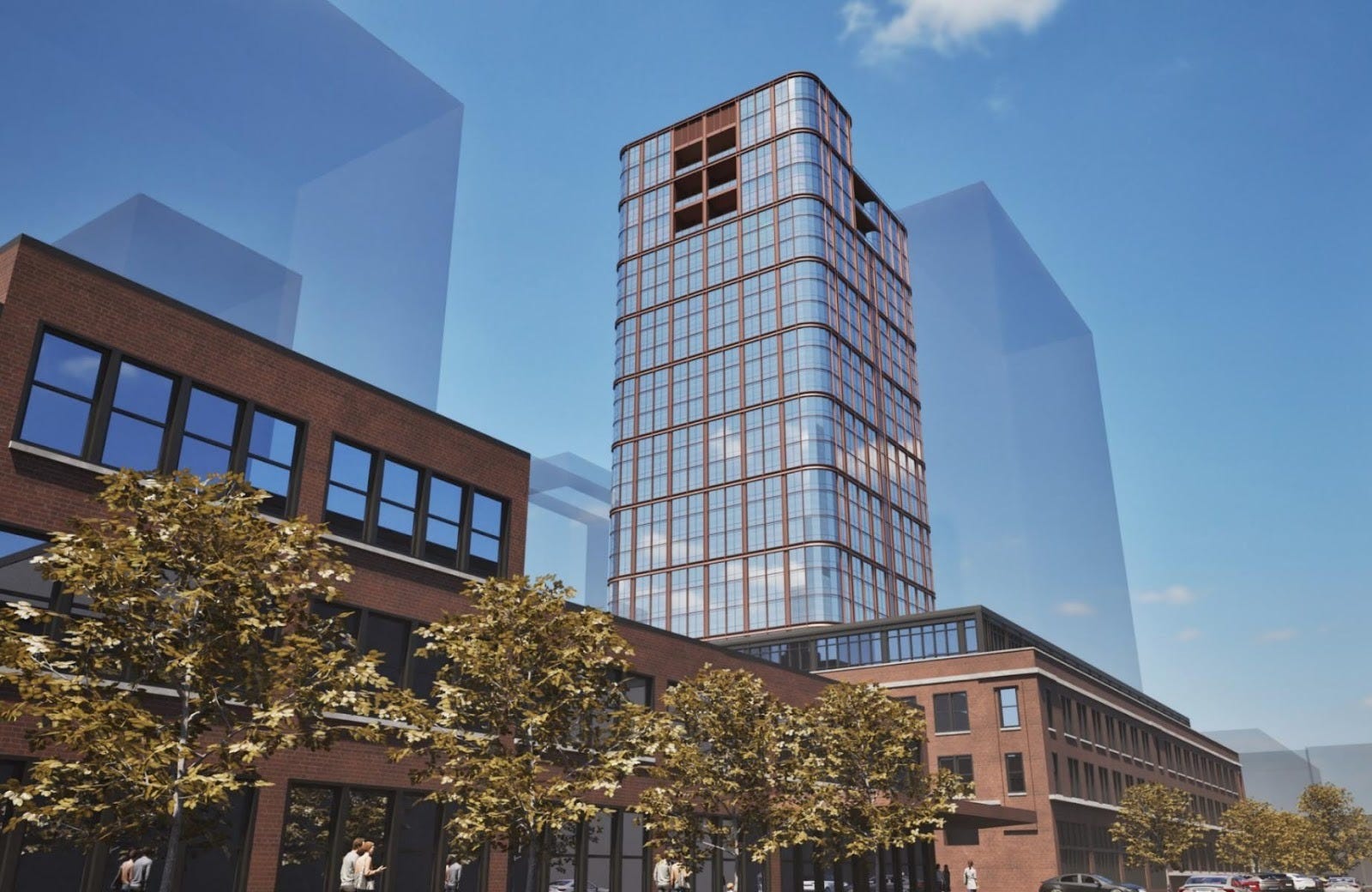
215 N. Racine. Source: Domus Group via Urbanize Chicago
In a city that regularly ranks dead-last among its peers for new housing production, Fulton Market has been a real bright spot. A steady stream of high rises has helped soak up demand for housing, and generate a lot of new tax revenue. Now, a new proposal could help accelerate that growth even further. But it’s running into a wall of opposition from an unexpected source.
In a really well-explained story Monday, Crain’s reported that a developer is proposing to build a new 30-story, 347-unit tower in Fulton Market. That’s in line with other nearby projects. But to get this one to work, they’re asking the city to upzone the plot of land to a level that’s historically been reserved for the city’s downtown.1
We could use another tower in Fulton Market. 347 new units would take a little pressure off Chicago’s relentless rent increases, and under city rules 20% of those units would be affordable for middle-income residents.2 The project would also include a high percentage of 2- and 3-bedroom family-style units, which is a rarity for new high-end developments.
That’s not all. The project would generate hundreds of good paying union construction jobs. It’d also trigger a hefty payment to the city’s Neighborhood Opportunity Fund, which redirects money from downtown development to support low-income South and West side neighborhoods. And by my math, the building would pay about $2M a year in property taxes to cash-strapped local governments.3
Now, normally this is the part where the realities of aldermanic politics intrude, and I tell you that a small number of local opponents have bent the ear of their Alderman to derail a project that would be good for all of us.
But that’s not the case! Local Alder Walter “Red” Burnett is open to the rezoning and has spoken forcefully about the need to build more housing for families. That’s a great sign. Burnett is new to City Hall, and the fact that he’s willing to stand up for more housing says good things about his judgement and political courage.
Instead, the opposition is coming from the City’s Department of Planning and Development. Crain’s reported that back in July, the planning department sent a letter to the developer, telling them that DPD would oppose approving a zoning change before the City’s Plan Commission – the first step towards getting the project approved.
Why is DPD opposing this rezoning? Well, because years ago, DPD came up with a plan for Fulton Market that zoned the corridor to a lower level than the developer wants today. Instead of a major upzoning, DPD suggested that the developer buy up neighboring development rights. That would allow the development to reach the same height, while not violating the planning department’s guidelines.
DPD’s approach would be extremely counterproductive. Requiring the purchase of development rights means the development will cost more and take longer to build (if it gets built at all). It also means those development rights don’t exist for a future proposal. If the city just upzones the parcel instead, there’s more zoned capacity available for future projects in Fulton Market.
DPD needs to get its act together here. Let’s hope Commissioner Ciere Boatright calls ensures her team supports this project when it appears before the Plan Commission next week.4 And even if DPD does remain opposed, there’s no reason for the Plan Commission to take their advice on this one.
Architects against architecture
But while DPD’s actions are frustrating, check out the comments in Crain’s from Eleanor Gorski, a former Deputy DPD Commissioner and the CEO of the Chicago Architecture Center:
Gorski said such a rezoning would throw out the rules all developers have had to play by in Fulton Market. Transforming a meatpacking district into a mixed-use neighborhood, she said, required years of study and public feedback on locations of new uses, historic preservation, development density, public services and open space, among other factors.
A DX-16 approval would set a precedent that compels the city to either embrace unlimited density in the neighborhood or revert to spot-zoning, Gorski said, the controversial and corruption-susceptible practice of rezoning specific parcels of land in a drastically different way from its surrounding area or as it should be under a comprehensive plan.
A few thoughts. First, Fulton Market exploded because 1) it was close to downtown, and 2) it was a meatpacking district filled with light industrial businesses that didn’t object to new development. I’m sure there were community engagement sessions involved, but DPD does community plans all over the place. It wasn’t the community engagement sessions that enabled the development – it was the lack of established NIMBYs.
Second, in a world of prerogative, it’s not clear how much precedent is really being set. It’s the law of the jungle out here, and Alders get to do what they want in their wards. I’m all for a citywide rewrite of the zoning code, but that’s not the world that we live in today.
DPD only gets to weigh in on this one because the project has to go to the Plan Commission, a separate body that weighs in before the zoning committee. Notably, the planning department doesn’t have a similar mechanism to oppose down-zonings. So if the planning department stands on principle here to oppose an upzoning, it’s just creating a one-way ratchet to lower the amount of future housing we build.5
And even if you do grant the argument that this would make a stronger case for more dense development in the West Loop, well, sign me up. We should make it easier to build dense housing where people want to live. As Bo McMillan noted last year, Fulton Market is one of the only neighborhoods in the city seeing an increase in low income households – precisely because it’s one of the only places where we’re actually building at scale.
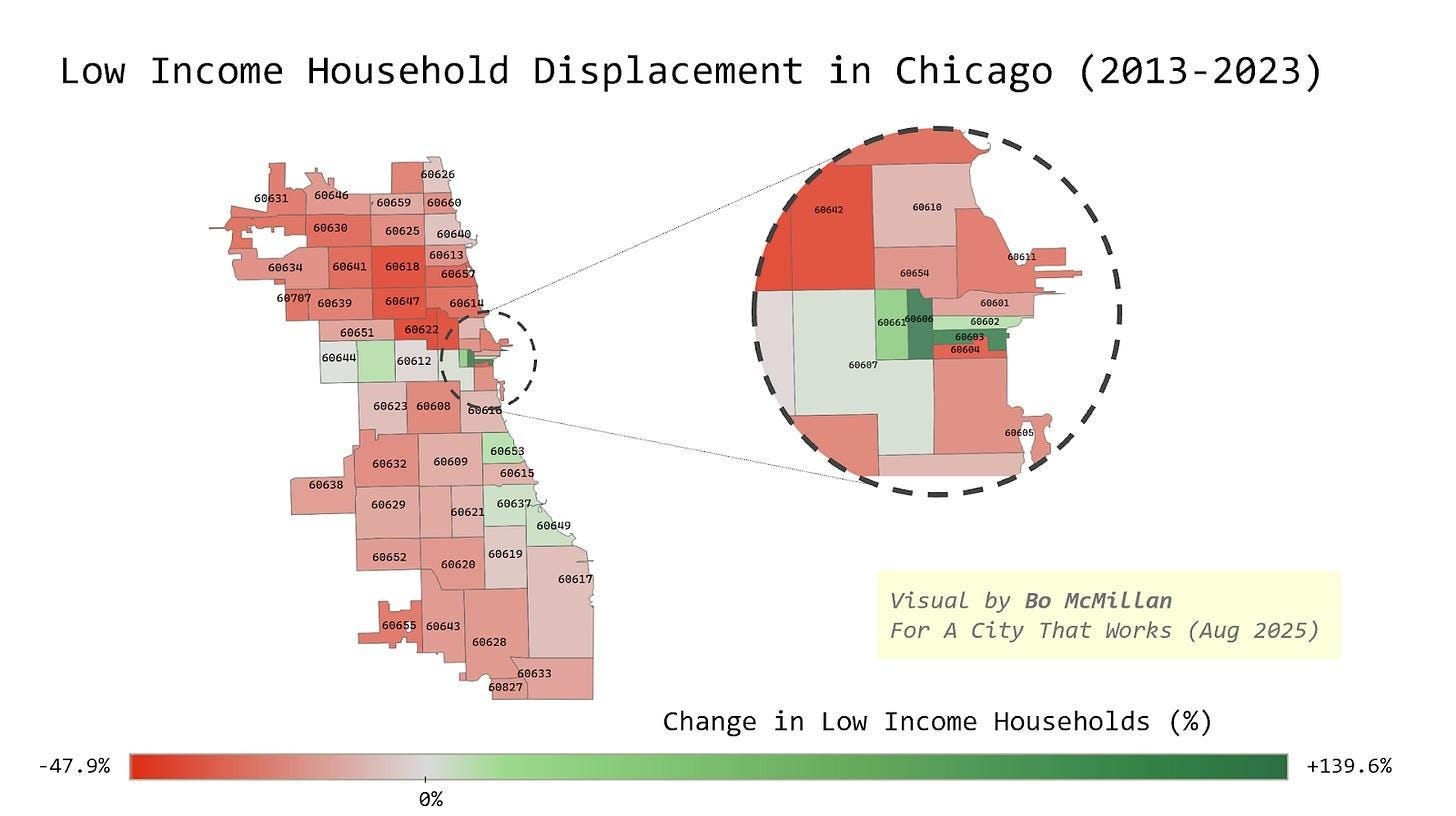
But most importantly of all, why is the CEO of the Chicago Architecture Center going to the media to oppose a Chicago skyscraper that would replace a surface parking lot?6
Our skyline didn’t emerge from endless community engagement sessions. And it certainly didn’t proceed in uniform fashion, with “years of public study and feedback on locations of new uses.” Here’s what the Wrigley Building looked like in 1922.
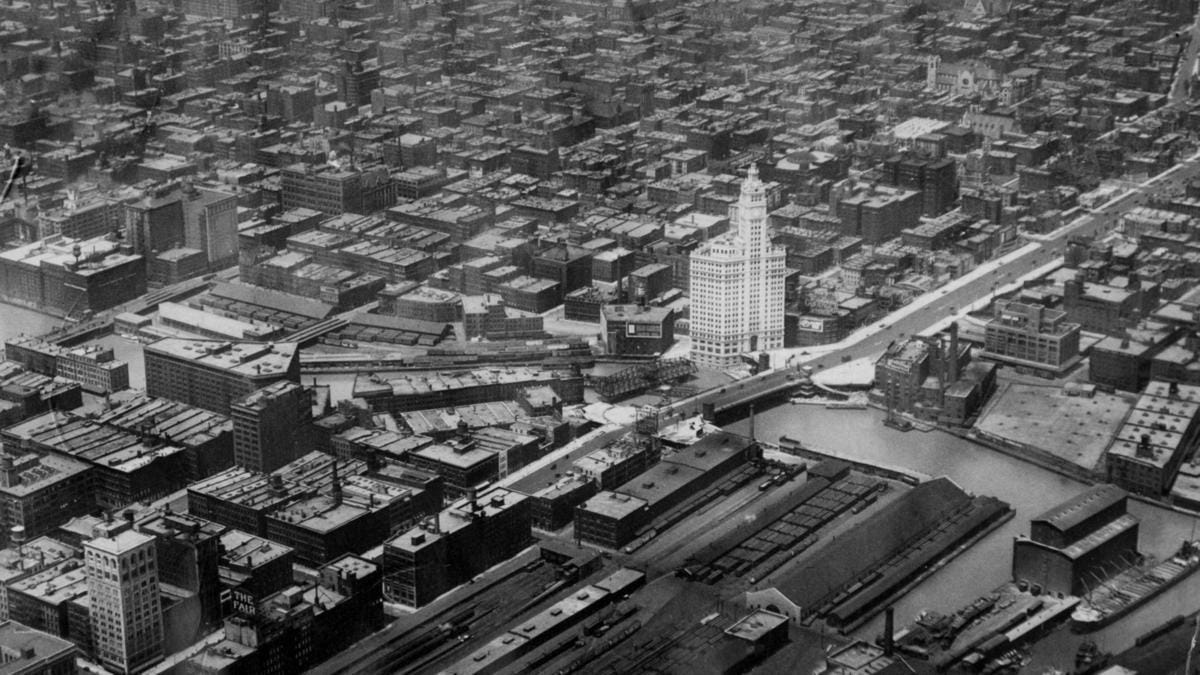
Source: Chicagology
It looks a little different from the rest of the neighborhood. You might call that difference “drastic.”
I think it’s a good thing that we built the Wrigley building. I’m sure Eleanor Gorski would agree – as would the many wonderful docents who highlight it on the CAC’s excellent boat tours. But there is something broken about an approach that champions the achievements of the past while blocking the ambitions of the present.
This is jarring in part because Gorski is usually a cheerleader and partner for new projects. This is the exception, not the rule. But it’s a pretty big one. There are only 4 big residential skyscrapers under construction in the city today.7 And it’s wild to come out swinging against this project precisely because it might get the city’s development trajectory on a better path.
Chicago is in the midst of twin affordability and fiscal crises, and we desperately need to build more housing. There are plenty of hard political barriers to doing so. It’d be nice if our planners and architects would at least start pulling in the right direction.
In our reader survey, many of you asked how you could get more involved. Here’s an opportunity.
215 N. Racine will be heard at a Chicago Plan Commission meeting on February 19. You can share your feedback on this zoning change by emailing the commission at cpc@cityofchicago.org. Make sure to include your name and the project address, and let the commissioners know if you happen to live nearby. Comments are being accepted up to 24 hours before the start of the meeting.
You can also reach out to Aldermen Burnett’s office and thank him for fighting to add more housing in his ward.
A DX-16 zoning designation, if you want to get technical.
At a 60% Area Median Income threshold under the ARO, a two-person household would be able to afford the unit while making $57,600 per year.
That’s based on the per-unit comps for 1044 W. Van Buren St and 354 N. Union Ave, two nearby buildings that were completed in 2023 and are now paying fully-assessed property taxes at a rate of $6,191/unit. If the developer builds all affordable units on site and takes advantage of Affordable Illinois tax incentives (as roughly a third of nearby buildings have), the property tax burden would fall.
Fun fact: 91 of the 117 page Plan Commission application is taken up by the applicant’s Economic Disclosure Statement. If that seems like an enormous waste of time and energy, you might want to check out Rohan’s piece from last week.
This is also a reminder that more approval layers create risk and delays, even if they *usually* wave things through.
And a small three-story building.
Defined here as residential projects with more than 300 units.
Housing politics is like an iceberg, the more you learn the farther down you go. The NIMBY stuff of local hearings, zoning is near the top. Financing, construction labor shortages, state capacity issues in public housing, surging building costs, restrictive building codes follow down the middle. And towards the bottom, you see the real sicko stuff: misanthropic architects and fire marshals setting policy on nothing but aesthetic, bad history, and their mood.
Hot take: DX-16 is rather non-dense for the most dense zoning code in the city that birthed the skyscraper.
And Chicago’s “densest” zoning codes are not that dense, and force buildings to build giant podiums that use land that could hold more high rises.