
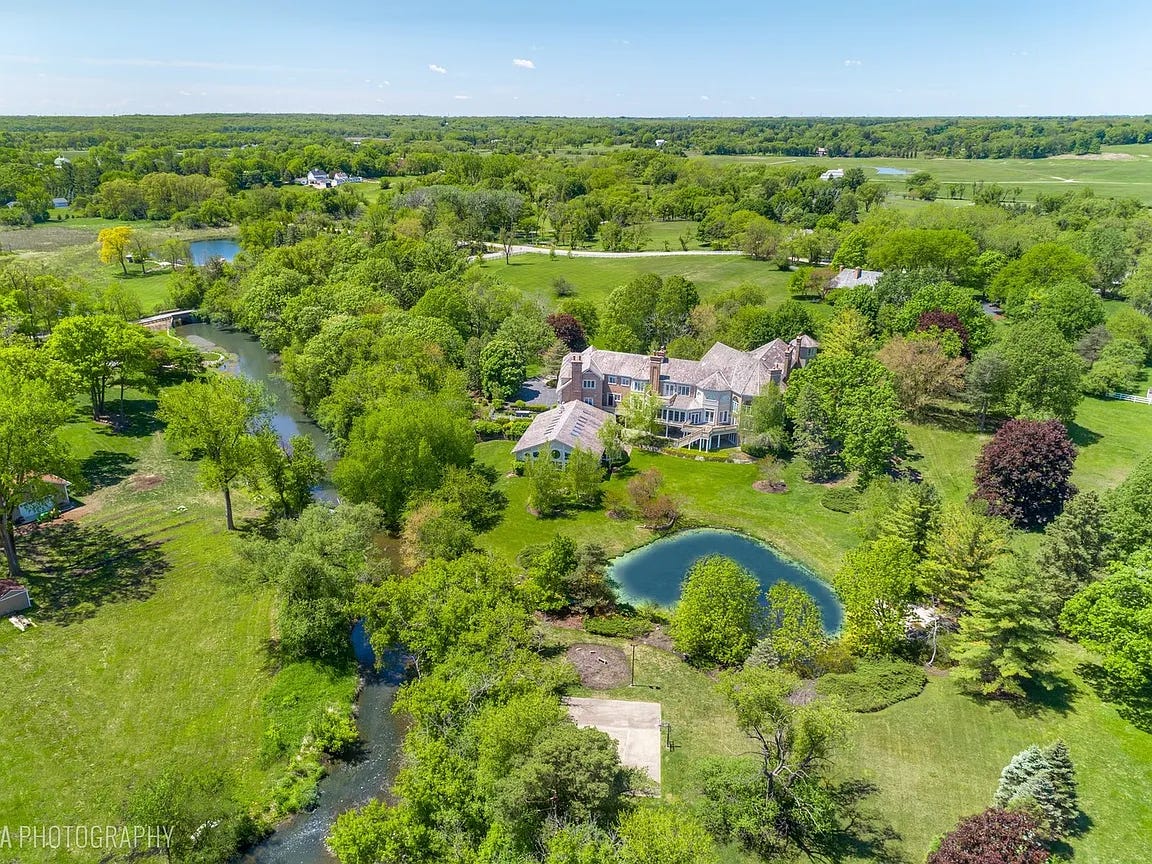
Barrington Hills, Illinois. The village, which has a minimum 5-acre lot size, was one of the first municipalities to come out in opposition to Governor JB Pritzker’s housing plan. Source: Zillow.
We have spent a fair bit of time covering Governor JB Pritzker’s ambitious housing plan. Illinois is short 142,000 homes today, and needs to build a total of 227,000 homes in the next five years to keep up with demand. The Governor’s plan could make a meaningful dent in that - helping reduce the pace of rent hikes across the state, and making Illinois a more appealing place to move to and live in.
Unfortunately while the Governor’s plan is broadly popular, it’s faced substantial opposition from local municipalities. It’s not crazy to be worried about sacrificing local control. And these opponents are a powerful constituency that has helped kill prior housing reforms. So today, let’s take a closer look at the economics and politics of housing *outside* Chicago, and the concerns that local governments have raised.1
We need more housing in the suburbs
First, and most importantly, our housing shortage is not just a City of Chicago phenomenon. In Bloomington, IL, median home prices more than doubled between 2019 and 2024. In the 7-county Chicagoland region, the total number of households grew by 6.8% over the last 10 years in the average municipality, but the number of homes grew by only 4.8%, according to data from the Chicago Metropolitan Agency for Planning.2 That’s a problem because by definition, each household needs a house. It’s not surprising that rents and asking prices have climbed rapidly as a result.
But if the short term problem is one of more demand than we have supply, the long-term challenge is even scarier. As housing gets more expensive, it starts to choke off demand – deterring newcomers from moving in, lowering the odds of family formation, and driving residents further out (or to other states). That’s a disaster for the state, and especially local property taxpayers: our state and local governments have high fixed costs and legacy pension obligations. A growing population spreads those costs over more taxpayers. But with a shrinking population, those legacy costs can quickly become a death spiral.
Municipalities have a collective action problem
Broadly speaking, building more housing is popular. In Illinois, recent polling indicates that 82% of voters want to see their state legislators address the housing crisis, and 65% said that state legislators should prioritize more homes, while just 18% preferred deferring to the power of city governments.
But it’s one thing to want more housing. It’s quite another to put up with construction, and traffic, and change in your backyard. And while the vast majority of residents who are unbothered by a development are unlikely to advocate for it (or be paying attention at all), you can count on a small minority to show up and complain.
That puts local leaders in a terrible bind. In Elmhurst Illinois, the average sale price of a home has jumped from $410,000 to $716,000 in the last 5 years. But if Elmhurst rewrites its zoning code to allow Accessory Dwelling Units, it won’t fix our housing crisis. Elmhurst is a drop in the regional bucket. A mayor who takes a stand on this won’t solve the housing crisis, but is guaranteed to get accosted by some angry long-time homeowners in the grocery store. So why bother?
You simply cannot solve a regional problem with a local government. And indeed - in case after case, the biggest housing wins have come at the state level: including blue States like California and Oregon, and red ones like Montana. Notably, because the result has been a little more housing everywhere instead of a lot more housing in one neighborhood, there has been minimal blowback on the state legislators who’ve led these efforts. In Oregon, State Sen. Tina Kotek, who helped spearhead that state’s housing reforms, landed a promotion to Governor.
Lobbyists for a dead end cause
Unfortunately, instead of ceding control over statewide problem to statewide government, a large number of municipal leaders are fighting tooth and nail to hold onto their power to block new housing. This effort has been quarterbacked by the Illinois Municipal League (IML), which represents units of local government in Springfield.
In its initial filings and testimony, the IML has made three primary arguments in opposition to the Governor’s plan:
Upzoning won’t improve affordability: The IML has cited a 2023 study by Urban Institute author Yonah Freemark, among others, that finds “no statistically significant” increase in additional low cost units.
State standards will create an undue burden on municipalities: That includes straining schools, local infrastructure, and confusing emergency response efforts.
Mayors and local governments are best positioned to address the housing crisis. Or, as IML Officer and Peoria Mayor Rita Ali put it: “Don’t preempt all of our authority. Instead, give us more authority to implement solutions locally.”
Let’s dispense with the first two issues quickly. On #1, the vast majority of peer reviewed studies find that lowering barriers to development increases housing production and affordability. That’s the consensus of literature reviews from experts in the field assessing the range of evidence on the topic.
The IML lobbyists are cherry-picking a single study that’s at odds with the broader literature base, and that *still* finds real benefits to legalizing more housing. Don’t take my word for it – here’s what Yonah Freemark, the study’s author had to say:
The study I coauthored cited by the IML found that zoning reforms did increase housing supply, and affordable rental housing increased, though inside the margin of error because of small sample sizes. Overall, studies suggest that zoning reforms can be successful in lowering costs, especially when they are done at a larger scale (such as statewide) rather than in smaller geographies. Conversely, rezoning for less density clearly leads to higher costs, and keeping land use policies as they are today could reinforce negative outcomes. State and local governments should continue to pursue land use reforms while also pursuing other strategies.
Concerns about infrastructure are also misplaced. The governor’s proposal includes $250 million in funding for infrastructure upgrades, and infrastructure like sewer systems generally operate well under capacity in most municipalities. Dense infrastructure is also generally much cheaper to support than sprawl - the fewer miles of sewer or road every taxpayer has to cover, the better. And while Illinois has many challenges, overcrowded schools is not high on the list: in the Chicagoland region, the number of individuals under the age of 19 has declined 24% in the last 10 years. Rather than worrying about overcrowded schools, we should be doing everything we can to avoid empty ones.
The foxes will tighten henhouse security any day now
But the biggest tell here is the claim that, if we leave things the way they are now, cities and towns across Illinois will act to address an affordability crisis that’s been building for decades. Year after year, rents rise and municipalities fail to act. And to the extent that the IML weighs in, it’s to maintain the status quo.
Under the provisions of Illinois’ Affordable Housing Planning and Appeal Act, the most unaffordable communities in the state (i.e., where less than 10% of housing units cost less than a month $1,181 to rent, or $1,575 to own), are required to submit an affordable housing plan that details their approach to creating low-cost or affordable housing.
These plans are not very demanding.3 But as researchers at Impact for Equity point out in a recent report, of the 44 municipalities in Illinois with almost zero affordable housing, 16 haven’t even bothered to submit a plan to add more housing, and another 18 have submitted plans that don’t comply with the Act’s provisions. 11 of those municipalities have come out in opposition to a centerpiece of the Governor’s plan, which would legalize 2- 3- and 4-flats on standard-sized lots statewide.4
You can see a full list of the positions taken by municipalities in the Chicagoland region, along with their most recent affordability statistics, in the table below:
I doubt we’d actually see many apartments built in these communities if the Governor’s bill passes - change takes time, and a lot of folks are willing to pay a lot for single family homes in these communities.5 But it’s the most extreme example of small, well-off communities opposing even minor changes to their housing stock. There’s a bill in Springfield this session that would (slightly) toughen the reporting requirements for these municipalities.
What’s the Illinois Municipal League doing? Naturally, it’s lobbying against tougher reporting rules for the most exclusive communities in the state. There is no version of tougher rules, or more housing that municipal lobbyists are willing to support.
To add insult to injury, because the IML is funded by local governments, your tax dollars are paying to oppose the governor’s housing agenda. A number of local governments have also gone out and hired their own lobbyists to fight the bill, which adds to the tab.
I don’t think you should really begrudge the IML here - an association that purports to represent local governments will do just that. But this sort of action should make it patently clear that local governments are incapable of addressing this crisis. It’s time for statewide reforms.
Readers often ask how they can get more involved in the issues we write about. In this case, there are three things that you can do today that will make a real difference.
Call (866) 558-7844. The good people at AARP have set up a hotline that will patch you through directly to the office of your state legislators. Phone calls count for a lot more than emails - and you don’t have to show up to early-shopping hours at Costco to participate.
Sign the Abundant Housing Illinois petition in favor of the BUILD plan, to let your legislators know you’re in support.
Contact your local government, and tell them to stop using your tax dollars to contribute to our statewide housing shortage.
To its real credit, the Johnson Administration is not lobbying against the package (although some Alders on the Northwest side are).
Note that this data does not include downstate Illinois, which has its own housing challenges and shortages. But the CMAP data is useful because it covers a large share of the state’s residents and legislators, and suburban municipalities have been some of the fiercest opponents of the package.
Hinsdale, for example, has submitted a plan that the state has deemed compliant, even though the Village hasn’t built any apartments since 2018.
If you’re keeping track at home, those municipalities are: Barrington Hills, Elmhurst, Glenview, Lake Forest, Lincolnshire, Oak Brook, South Barrington, Spring Grove, Tower Lakes, Wayne, and Winnetka.
And that’s ok! The goal of the bill is to allow the construction of slightly denser types of housing - not to mandate it.
The irony of the opposition by cities is that they are proving the state's point masterfully. Cities aren't willing to tackle our housing crisis, and we can't continue to let their obstinance make the problem worse.
Nobody should be able to opt out of sensible housing, because the second they can, everyone will because nobody wants to have to handle all the development pressure on their own.
A universal disarmament is the fairest way, and would actually prevent the catastrophic massive amounts of change they are so worried about, by diluting it reasonably across the state. The short-sightedness is astounding.
Glad the IML is getting the call out it needs