
July 27th | Logan Square / Avondale Happy Hour: Come on out to talk housing, schools and anything else with the City That Works team. We’ll be at Ludlow Liquors starting at 5:30, and will be joined by Carlos Rivas (CPS School Board District 3B member), Pete Gonzales (running for School Board in District 3A), and Daniel Tobon (running for Alder in the 35th Ward). Our events are always free, but it’s helpful if you register here to let us know you’re coming.
On June 30th, the City of Chicago published its 2025 Annual Comprehensive Financial Report. There’s a lot worth unpacking from the full report, but for today’s purposes I’ll focus on our pensions, since the ACFR provides a nice summary we can use (as we did last year) for an annual check-in on how the system’s going.
An overview of 2025
As a recap of our starting point: as of the end of 2024 (e.g. last year’s numbers), the combined four pension systems (Police, Fire, Labor, and Municipal Workers) stood at 25.4% funded, with $12.42 billion in assets against $48.95 billion in liabilities (a net unfunded liability of $36.53 billion). Here’s what’s happened since, from the city’s 2025 Annual Comprehensive Financial Report:
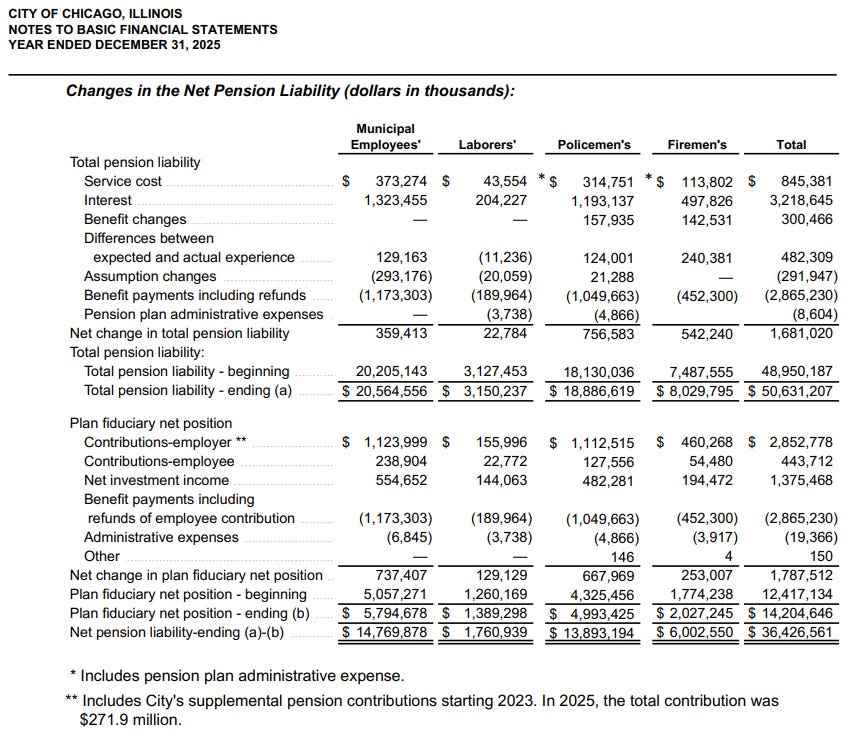
Relatively speaking, things went quite well last year. Fair value of the assets rose by 14.4%, from $12.42 billion to $14.20 billion, with a net investment gain of around 11% ($1.375 billion). For three of our four funds (all except Laborers’), contributions outpaced benefits paid, so we are making net progress in growing the asset base from contributions alone.
On the liability side, most things look pretty normal. It’s worth noting that because prevailing interest rates have changed a bit, we now have a higher assumed discount rate for the Municipal and Laborers’ funds1, which translates to a lower total liability (by about $310 million) and a lower assumed discount rate for the police fund’s liabilities, which translates to a higher total liability (by about $21 million). The other big change was a legislative one - the passing of PA 104-0065 (or HB 3657, the Tier 2 sweetener for police and fire pensions), which added $300.4 million in liabilities to the system per the ACFR. We’ll talk about this more in a bit.
Combining those two: we started the year at $12.42 billion in assets against $48.95 billion in liabilities for a 25.4% funded rate and a $36.53 billion net liability. We ended the year at $14.20 billion in assets against $50.63 billion in liabilities for a 28.1% funded rate and a $36.43 billion net liability. That’s pretty solid progress.
The Impact of PA 104-0065
One of the most surprising pieces to me was how small the immediate impact of the Tier 2 sweetener (PA 104-0065) for our police and fire pensions was on this year’s financials. Per the ACFR, it only added around $300 million in liabilities as of 12/31/2025, despite reporting last fall indicating an impact of $11 billion to the pension funds. I’ve asked the Department of Finance for some clarification about how they’re thinking about those numbers, but haven’t yet heard back as of now. I’ll update as soon as I do.
As Ald. Bill Conway points out on Twitter, however, the most logical explanation simply has to do with GASB accounting standards. Our pension liability as reported in the ACFR accounts for all pension liabilities earned to date, while most of the expected impact of the legislative change is on benefits earned in future service years. You can actually see this more clearly in the contribution schedules reported by the PABF and FABF (in their annual actuarial reports) - The 2024 fund reports estimated they’d need $56 billion in total contributions from 2026 to 2055; the 2025 reports show an additional $8.3 billion in contributions over the same timeframe:
A short-term win for active management
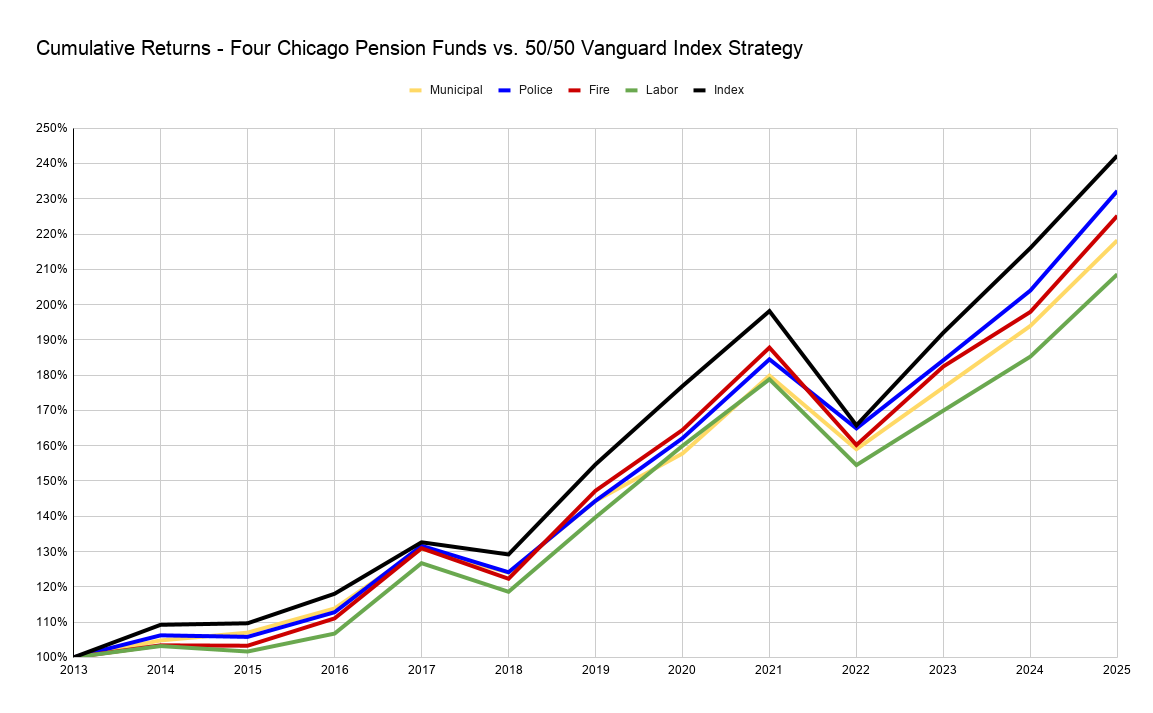
Next, I feel obligated to refresh my annual exercise of how we’d do under passive management. In past years, I’d found that a passive management approach (just ‘buying the index’) could save us something like $30-40 million per year in management fees without impacting returns. That remained true last year as well.
This year, active management looks a bit better. The 2025 money-weighted rates of return for the Municipal, Police, Fire, and Labor funds were 12.5%, 13.85%, 13.77%, and 12.6%, respectively, per the funds’ individual ACFRs. If you instead deployed a passive strategy, putting 50% of funds into Vanguard’s total stock market and total bond market funds, you would have instead generated a 12.14% return for the year. That makes this the first year since 2022 that active management beat the passive strategy (though I’d still point out that over a longer time horizon, passive management remains ahead, and as such I remain convinced that a transition is a good idea).
Digging in further
All in all, there’s actually some good progress showing up here, though the journey out of our mess is still quite a long one. It’s also worth noting that we’ve now had three straight years of really solid returns - averaging over 11% annually - and in that time our funded rate has just increased from 22% to 28%. What happens next time the market has a bad year? It’s easy to imagine a lot of that progress going away, which is why it’s so important to keep chipping away at our liabilities wherever possible.
Our pension debt remain our greatest fiscal challenge as a city, and it’s important that we continue to deal with that reality responsibly. If you’re interested in exploring more, we’ve put together a new dashboard to dive into exactly how our system got so underfunded, the impact that has on our finances today, and what it’ll take for us to climb out of the hole - please check it out at pensions.acitythatworks.org and let us know what you think.
A brief note on mechanics: remember that our total pension liability is the present value of all projected benefit payments which have been earned to date. The present value bit is important because it means a dollar of pension benefits paid in 2027 is more expensive than a dollar of pension benefits we have to pay in 2055. To calculate the PV, we discount back those future payments by some rate, and a higher discount rate translates to a lower PV on the same amount of future benefits paid.
the pension dashboard is new and looks great! love the scenario modeling! new website (https://acitythatworks.org/) looks spiffy too - one small cosmetic change is that I wish the favicon in the browser tab for both was a little more representative of ACTW. could be a fast little change with your favorite coding agent :)
Why do you not include city sister agency pension/OPEB debt (mostly CPS)?